By David Rubinstein
With the sample size of participating companies having tripled in one year, the folks behind the Building Security In Maturity Model (BSIMM) have found that most have an internal group responsible for security, and that 15 activities to ensure security are almost universally done.
The BSIMM project began in March 2009 as a joint effort between Cigital and Fortify Software to record what organizations are doing to build security into their software and organizations. Starting with input from nine companies, the number of participating organizations has grown to 30, according to Gary McGraw, CTO at security consulting firm Cigital. He said the larger sample size allowed the group to statistically validate the model, and that the levels for measuring security are sound.
McGraw explained that the BSIMM team observed 109 activities that the 30 organizations do to secure their software, and those activities are broken down into 12 “large-scale conceptual buckets,” he said, such as training or code review. Then the activities within those buckets are further divided into three levels: The things that most of the organizations do are at the first level, while level 3 is for “the rocket science, things that are rarely done but are very cool,” he added.
Organizations can download BSIMM2 to compare their own activities to what other groups are doing and plan their security strategy going forward, explained Brian Chess, cofounder and chief scientist at Fortify Software, which makes vulnerability detection software and provides security services.
Chess said that the companies studied all do good hosting and network security. “They all have firewalls, that’s no great revelation,” he said. “But there are 14 other activities that almost all the companies universally do.”
 Synergetics India : Our Database Offerings experience help to reduce the Opportunity cost for our clients in terms of development time specially related to latest in technology.
By Kevin McLaughlin, ChannelWeb
Microsoft didn't do badly in its fiscal 2010 third quarter, certainly a lot better than it did in last year's Q3 when it reported the first quarterly revenue decline in company history. But in the eyes of investors at least, Microsoft's results were less than stellar.
As expected, Microsoft's results were buoyed by Windows 7. The Windows and Windows Live division reported revenue of $4.4 billion, up 28 percent from the $3.4 billion it reported in last year's quarter. Given the Microsoft's OEM channel accounts for about 80 percent of total Windows revenue, this jump is linked to sales of new PCs.
"Business customers are beginning to refresh their desktops and the momentum of Windows 7 continues to be strong," Kevin Turner, COO, Microsoft, said in a statement.
For the quarter ended March 31, Microsoft's net income rose 35 percent to $4.01 billion, or 45 cents per share, compared to $2.98 billion and 33 cents per share in the year-ago quarter. Overall revenue during the quarter was $14.5 billion, up six percent from the $13.6 billion the company pulled in during the year-ago quarter.
Despite the strong numbers, Microsoft investors were apparently not satisfied, as Microsoft shares were trading down 40 cents at $30.98 in after-hours trading.
Microsoft's Server and Tools division revenue was $3.5 billion, up two percent from last year, while Microsoft Business Division revenue dropped six percent to $4.2 billion during the quarter, which the company attributed to $305 million in deferred revenue for its Office technology guarantee program, which allows customers that buy Office 2007 in advance of the Office 2010 launch to upgrade to the new version.
Online Services division revenue grew 12 percent to $566 million due to a 19 percent jump in online advertising revenue, according to Microsoft. This number includes a $154 million charge for transition expenses stemming from Microsoft's search partnership with Yahoo. Microsoft's Entertainment and Devices division revenue was up slightly at $1.66 billion.
"Windows 7 continues to be a growth engine, but we also saw strong growth in other areas like Bing search, Xbox LIVE and our emerging cloud services," said Peter Klein, CFO, Microsoft, in a statement.
 Synergetics is a premium brand in the Indian IT industry in the area of people competency development engaged in delivering it thru its training and consulting interventions; primarily focusing on their productivity with regards to the project and deliverables on hand
From SDTimes, By Katie Serignese
To open its platform to a wider pool of developers, particularly Web developers, Symbian announced in late April the availability of its new Web application development tools.
The open-source tools are built on top of the Eclipse JavaScript Debug Toolkit project and add mobile-specific capabilities to enable the transition from desktop development to mobile development. The capabilities include mobile application previewing, debugging, project creation and mobile API support.
With these new tools, any Web developer can apply existing skills in CSS, HTML and JavaScript to create an application for the open-source mobile platform, Symbian 3.
The non-profit organization took this approach to ease the creation of apps and widen the pool of developers for them, said Larry Berkin, head of global alliances at Symbian. He also noted that there are a lot more Web developers out there than native developers.
Despite still being the most widely used operating system in terms of the sheer numbers of phones using it, Symbian has fallen behind in popularity since the introduction of Apple’s iPhone and Google’s Android operating systems, said Theresa Lanowitz, CEO of technology analyst firm Voke.
Lanowitz added, however, that she thought “[Symbian] always had a good road map” as far as development, but it lacks a connection with customers.
Another way Symbian is trying to tap into the reservoir of Web developers is by offering JavaScript APIs as a way to create more-robust applications. This will give developers a means to create more-capable applications with access to contacts, an accelerometer, a GPS and a camera, among other features.
The tools can be used on Linux, Mac OS X and Windows operating systems, and will supplement the Nokia-owned Qt framework that already supports application development for the Symbian 3 platform.
 Synergetics is Awarded as the "Best. NET Training Service Provider" by Microsoft.
From SDTimes, By Alex Handy
Writing applications for cloud environments is a different affair that writing for in-house hosting. At the All About the Cloud summit in San Francisco this week, the focus was on what changes developers need to make to their applications to enable their optimal use in the Cloud. Perhaps the most interesting revelation offered during the event was that of the direct correlation between billing and the quality of source code.
Treb Ryan, CEO and founder of OpSource, said in a keynote talk that Cloud hosting offers “the best margins I have seen in the hosting business.” He added that Amazon has largely played down the profitability of Cloud hosting, and he suggested they have done so to scare off potential competition. OpSource has been offering hosting for software-as-a-service applications for more than five years and has relatively recently entered the Cloud hosting business.
Ryan said that applications hosted in the Cloud are under a performance microscope. If they send too many requests to the database, that will be reflected by a higher bill at the end of the month. He said that developers writing applications for deployment in the Cloud need to realize that “bad code costs me twice as much as good code. I can cut my op costs in half” by optimizing the code.
Thus, said Ryan, developers can see a direct correlation between the code they've worked on all month and the reduction in their Cloud hosting bill. That's something developers haven't really been able to do since the days of mainframes and time-sharing.
Elsewhere at the All About the Cloud summit, attendees and speakers discussed the remaining problems of the Cloud. Integrating Cloud applications with on-site systems was one of the first and most painful points discussed.
Paul Daugherty, chief technologies architect at Accenture, said, “We are at an inflection point where integration becomes more critical. Increasingly we're seeing a big increase in data sources used. Initially integration was about two different applications, but now it's getting into the 10s and 20s.
"There was an interesting piece of research Gartner did: They looked at companies using SaaS applications. One of the less obvious data points out of their sample respondents was that 14% or 15% adopted SaaS, then reversed back out onto on-premise. The No. 1 reason for that is cost of integration, and cost required was too great."
Another remaining Cloud issue is security, said Ryan. “We're still addressing security. The idea that the vast majority of Cloud environments have the same user name and password for all users is ridiculous."
He added that most Cloud providers do not currently offer a way to tie multiple accounts together, and thus whole companies sometimes use the same login and password for their Cloud environments. Instead, Ryan would prefer accounts that could be used by each user, but could also be tied together for collaboration on the same virtual machines within the Cloud.
 Synergetics is a premium brand in the Indian IT industry with an experience base of over 15 years in the area of people competency development; engaged in delivering it thru its training and consulting interventions , primarily focusing on their productivity with regards to the project and deliverables on hand
By David Worthington
Oracle today has announced its acquisition of AmberPoint, a maker of SOA management software.
AmberPoint's SOA Management System solution is focused on resolving issues in application performance and transaction monitoring. The financial terms of the agreement were not disclosed, and the transaction is expected to close during the first half of this year, according to Oracle.
AmberPoint has partnerships with HP, Microsoft, Parasoft, SAP and TIBCO. Oracle will continue to support multiple platforms "even if the relationship ends," and it will support OEM agreements going forward, the company said in a conference call with the press.
"My guess is that Oracle will terminate many of these relationships," said Anne Thomas Manes, vice president and research director for Burton Group. AmberPoint, which is the "clear leader" in the SOA management market, is an "excellent acquisition" for Oracle, she added.
"I view SOA management as the most useful piece of SOA infrastructure an organization can buy, yet very few organizations have bought one," Manes said.
"The big vendors have universally promoted ESB as the foundation of a SOA infrastructure, and they've traditionally played down SOA management. I have the opposite perspective; SOA management should be the foundation of the infrastructure, and ESBs are less important."
Oracle intends to integrate data from AmberPoint’s governance runtime into its Fusion middleware products, including Oracle Enterprise Manager, Oracle SOA Governance and Oracle SOA Suite, the company said.
"We expect the addition of AmberPoint's products to Oracle Fusion Middleware SOA Suite will provide stronger end-to-end governance that allows customers to manage the entire life cycle of SOA-based solutions, providing visibility and management across heterogeneous environments," said Thomas Kurian, Oracle executive vice president of product development.
"I doubt that Oracle will start to downplay ESBs, but I expect they will start to aggressively promote SOA management," Manes said.
 Synergetics is a premium brand in the Indian IT industry in the area of people competency development engaged in delivering it thru its training and consulting interventions; primarily focusing on their productivity with regards to the project and deliverables on hand . Its primary differentiator has been its solution centric approach and its comprehensive client focused service portfolio
Introduction
We live in a digital world!! Every interaction is a “transaction”, and recorded into the computer’s storage.
So, what is the primary need of capturing this transactional data?
· Proof of Interaction
· Grain for Business Analysis
· Case for Predictive Analysis
As we have digitized every piece into a bit, the challenge faced today is more in terms of
· Volume of Data and,
· The disparate forms of Data in a Domain.
As mentioned, data has a purpose to serve; the major is that of participating in analysis, leading to the intelligence required by the business to make informed decisions.
In this multi part blog series, we will try to cover the need, along with the design & implementation practices for a Business Intelligence Application.
The Framework for Business Intelligence
A Business Intelligence Application, from a layered architecture perspective would be represented as shown in Figure 1.
This framework is conceptual, and technology agnostic.
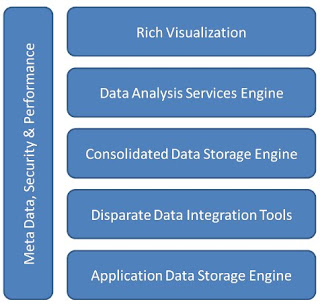
Figure 1.
1. The Data Integration will result in the Consolidated Data Storage
2. Data Analysis and Rich Visualization such as decomposition trees will use this Consolidated Data
3. The Consolidated Data can be termed as Data Warehouse OR Data Mart.
In the next blog, we will explore the Application Data Layer.
Until then; Cheers!!  Synergetics is Awarded as the "Best. NET Training Service Provider" by Microsoft.
On beye networks 19th Jan 2010
OracleAnnounces the Integration of Oracle Hyperion Planning and Oracle’s Demantra Real-Time Sales and Operations Planning
• To improve operational alignment and financial performance, Oracle recently announced the integration of Oracle Hyperion Planning and Oracle’s Demantra Real-Time Sales and Operations Planning.
• Linking Hyperion Planning and Oracle’s Demantra Sales and Operations Planning gives CFOs and supply chain executives a direct path to evolve from a disconnected enterprise and operational planning environment to integrated business planning.
• As a result, CFOs get a reliable revenue forecast that has been validated against the current operating plan. On the operations side, supply chain and manufacturing managers can reconcile current operating plans against updated financial targets and budgets.
• With its top rated Enterprise Performance Management applications now linked to its best-in-class Real-time Sales and Operations Planning application, Oracle is first to provide customers with true integrated business planning capabilities.
Integrated Business Planning Improves Visibility and Profitability
• Leveraging Oracle Application Integration Architecture (AIA), (AIA), this integration enables Oracle Hyperion Planning to publish the financial targets for revenue, profits and other metrics to Demantra Real-Time Sales and Operations Planning. This improves decision-making through increased visibility into financial goals and helps improve the quality and profitability of the supply chain operations and demand shaping activities.
• Demantra Real-Time Sales and Operations Planning provides the current operating forecast and cost of goods sold data to Oracle Hyperion Planning. This operating forecast is delivered in monetary units and enables financial analysts to identify any gaps between the financial plan and current operating plan.
• Customers will gain additional benefits from adopting Demantra Demand Management, which enables a global demand planning process that senses local demand changes, generates an accurate forecast and supports a cross-functional consensus planning process.
• With this integration, data can be moved seamlessly, preserving the user interfaces from Hyperion Planning and Demantra so that new training or re-implementation is not required.
Supporting Quote
• “One key aspect to developing a strategic, actionable operations plan is to integrate it with validated revenue forecasts and to be able to reconcile the operating plans against a real-time budget,” said Gartner Research Director, Tim Payne. “Today, integrated business planning is becoming a valuable strategy as companies are realizing the importance of aligning their operational, strategic and financial plans.”
• “CFOs are continually looking to improve the accuracy of their financial forecasts," said Oracle Vice President, John O’Rourke. "This unique combination of Hyperion Planning and Demantra Sales and Operations Planning helps ensure that the financial plan is feasible, and will provide more accurate financial results.”
• "One of Oracle's core principles is to improve alignment across the enterprise,” said Oracle Vice President, Applications Strategy, Jon Chorley. "Oracle Demantra Sales and Operations Planning is a proven, best-in-class solution to achieve cross-line-of-business alignment at the operational level. Hyperion Planning does this from a financial perspective. This integration combines these two powerful capabilities to deliver alignment across the entire enterprise."
General Availability
The integration between Oracle Hyperion and Oracle’s Demantra Sales and Operations Planning is available today.
Supporting Resources
* Oracle Hyperion Planning
* Oracle’s Demantra Real-Time Sales and Operations Planning
* OracleValue Chain Planning Applications
* Oracle Value Chain Planning Blog
* Oracle Enterprise Performance Management and Business Intelligence
* Oracle Application Integration Architecture
* Cabot Microelectronics Reduces Forecasting Cycle Time by Nearly 50 Percent with Oracle’s Real Time Sales and Operations Planning Solution
* Gartner Market Scope for Sales and Operations Planning
 Synergetics is Awarded as the "Best. NET Training Service Provider" by Microsoft.
 Synergetics India : Our Database Offerings experience help to reduce the Opportunity cost for our clients in terms of development time specially related to latest in technology.
