Showing posts with label india. Show all posts

Wednesday, March 9, 2011

Microsoft tries to allay enterprise fears about Windows Phone 7

On Computerworld, By Matt Hamblen.

LAS VEGAS - Some users of Microsoft's Windows Phone Series 7 will face a major hurdle when the mobile OS appears in devices during the 2010 holiday season -- it isn't backwards compatible with Windows Mobile 6.5 and earlier versions.

Microsoft may not view the lack of compatibility as a hurdle because it is looking for the new software to take it in a drastically new direction. However, enterprise adopters of earlier Windows Mobile might see things differently.

To its credit, Microsoft will allay some enterprise fears with its promise to support Windows Mobile 6.5 for a long time. Michael Chang, the senior product manager on Windows Phone 7, yesterday reiterated earlier vows made by CEO Steve Ballmer and others to keep on supporting Windows Mobile 6.5.

We will continue to support, ship and sell 6.5, Chang said in an interview at the CTIA Wireless conference. Windows Phone 7 is a departure and a break at a code level. Doing so wasn't an easy decision. It's a tough decision to move away from a platform like Windows Mobile, but one we were willing to make.

Ballmer has said Microsoft screwed up on Windows Mobile, and the company apparently hopes that the new Windows Phone 7 can help restore Microsoft's slipping share of the mobile operating systems market.

Asked whether Ballmer is pushing the Windows Phone 7 team to attain specific market share numbers, Chang said, not publicly.

Jeff Bradley, senior vice president of devices at AT&T, said that his company is looking forward to having Windows Phone 7 devices use its network. Other major U.S. carriers have endorsed the Microsoft OS as well.

Windows Mobile has become the enterprise standard OS for certain vertical segments," Bradley said in an interview. However, he added, "it has fallen back. But give Microsoft credit. They've taken 6.5 and made a break for something new. They've raised the bar substantially with Windows Phone 7.

Bradley noted that Microsoft's move to develop a Windows Phone 7 interface that's similar to its Zune digital media player likely won't be an allure to many users. Zune has not been widely adopted, he noted.

Even so, Bradley said he expects that Windows Phone 7 will have a browser that is very, very comparable to any smartphone on the market.

Chang said that while Microsoft expects to offer a rich multimedia experience on Windows Phone 7 devices, the OS initially won't include Adobe Flash player. We won't support Flash at general availability, although we do have a very deep relationship with Adobe, he said.

Chang said that adding consumer friendly features like multimedia support and rich browsing to its mobile operating system doesn't mean that Microsoft will abandon its place as a supplier of enterprise handhelds, including some rugged ones.

We think of this OS as an extension & of our scope, Chang said. I wouldn't say we are building a consumer phone at the expense of our heritage work productivity. We are taking that and adding to it features that include entertainment and a focus on a new experience. Windows Mobile was all about productivity, but we had relied on someone else to deliver a great experience. Not anymore.


Synergetics is Awarded as the "Best. NET Training Service Provider" by Microsoft.


'Midori' concepts materialize in .NET


By David Worthington

Some of Microsoft’s latest technologies could be green shoots on a migration toward its "Midori" operating system, according to analysts who are familiar with the project.

Recent additions to the .NET Framework adhere to the concurrent programming principles outlined in the Midori documents that SD Times viewed in 2008. Silverlight and the Windows Azure platform could also be complementary to a potential release of Midori, the analysts said.

Midori is a technology incubation project that was born out of Microsoft Research’s (MSR) Singularity operating system, the tools and libraries of which are completely managed code.

Microsoft has designed Midori to be Internet-centric with an emphasis on distributed concurrent systems. It also introduces a new security model that sandboxes applications.

"Midori is an attempt to create a new foundation for the operating system that runs ‘inside the box,’ on the desktop and in the rack. As such, it's willing to break with compatibility (or at least wall off compatibility to a virtual machine)," explained Larry O’Brien, a private consultant and author of the "Windows & .NET Watch" column for SD Times.

Microsoft may be laying a foundation for Midori in its existing development stack through languages and Silverlight as a runtime, O’Brien said. Microsoft Research is also increasingly focused on reasoning about concurrent programs, he added.

These major architectural transitions require developers to make a “conceptual leap” to a new model of programming, and to relearn how to program in an efficient manner, said Forrester Research principal analyst Jeffrey Hammond.

"We're seeing a gulf opening up right now between serial and parallel programming; only a small minority of rocket-scientist types can actually write code that works effectively in a parallel, multicore world,” Hammond added. “I think it's pretty clear that Midori is on the other side of that scale-out gulf. From a development point of view, those that can make the leap solidify their skills and employment opportunities for the next decade and beyond."

When asked whether there were any new developments in the Midori project, a Microsoft spokesperson said, "Microsoft is always thinking about and exploring innovative ways for people to use technology. Midori is one of many incubation projects under way at Microsoft."

Green shoots

Microsoft's F# programming language, which will ship this month with Visual Studio 2010, "hugely fits" the Midori programming model that was outlined in Microsoft’s documents, O’Brien said. F# is designed with restrictions that are intended to make it easier for developers to automatically parallelize applications, he explained.

For instance, F# is highly immutable—meaning that object states cannot be modified once created—and has an implicit type system. Midori requires developers to follow a similarly constrained model.

"Immutable variables are pretty much the opposite of how most programmers think about variables ('A variable that doesn't vary?'). So just a few years ago, the idea that functional programming was going to catch on seemed very dubious, and it was very surprising that F# became a first-class language so quickly," O'Brien wrote in an e-mail.

"Similarly, immutability and strong typing make it easier to reason about security," he added.

O'Brien questioned whether F# would become a more prominent language, or if Microsoft would evolve C# to have more of the same constructs that support automatic parallelization.

Automatic parallelization was a "big question mark" in Microsoft's Midori documents, he said. "One thing I've been noticing is that MSR is producing tons of stuff on reasoning about concurrent programs, exploiting latent parallelism ‘automatically.’ "

Microsoft must evolve the .NET Framework Common Language Runtime further to fully exploit the advantages of functional programming, O'Brien said.

Microsoft also has rapidly developed its Silverlight runtime. The Midori programming model includes Bartok, an MSR project that endeavored to create a lightweight compiled and managed runtime system that was more efficient than the .NET Framework.

"There's no question that Microsoft is seeing Silverlight as the lightweight platform for delivering applications (Web-based and mobile). As far as Midori and [Windows] Azure go, what I can see is that a Silverlight front end is a good front end for an Azure-powered back-end system," O'Brien said.

An Azure tie-in?

It would make sense for Microsoft to use the Azure platform as a vehicle for introducing Midori, Forrester's Hammond said. "It's essentially a .NET-centric (and Internet-centric) scale-out runtime.

"A distributed network-aware OS is the perfect thing to host in the cloud, and what better place to knock out the kinks than your own data center, where you have 100% control over the hardware and infrastructure you're testing on? This also allows them to test it underneath parts of the overall infrastructure: for example, hosting an individual service," Hammond explained.

Further, Microsoft is battling for new territory—distributed applications—with the Windows Azure platform, O'Brien said. As such, the platform has little legacy codebase, as well as ample funding in money and talent, along with new challenges, he added.

"While I don't think that we know if Midori would work as something fed ‘down the pipe’ to the consumer, the idea that Azure might ultimately benefit from its own operating system is definitely worthy of debate," O'Brien said.

O'Brien said that Microsoft might launch Midori as a new operating system for cloud data centers to up the ante against Google, which has developed new programming languages for writing distributed applications.

Midori's strong emphasis on concurrency issues, a willingness to break compatibility, and the idea of using a hypervisor "as a kind of Meta-OS" would fit that strategy, O'Brien observed. However, he noted that there is no concrete knowledge about the state of Midori or even that its design is necessarily attractive for a data center OS.

Microsoft does not have the lead in cloud computing, and it is rolling out new features for the Windows Azure platform to stay competitive with Amazon and Google, O'Brien noted. "At this stage, Microsoft cannot build Azure bottom-up. But the risks of retrofitting Azure to a new OS are vastly less than the unknowns of putting a new OS onto all the world's hardware."

The status of Midori

While the company has remained tightlipped, some information relating to the status of the project has become available. Midori team member Jonathan Shapiro departed Microsoft in March, citing personal reasons.

Microsoft recruited Shapiro from the BitC language and Coyotos operating system projects to work on Midori. He served on a team of high-profile programmers reportedly led by Microsoft senior vice president of technical strategy Eric Ru

dder.

Whether Rudder's focus has shifted away from Midori onto other projects in unknown. He recently presented at TechEd Dubai in early March on the topic of Microsoft's "three-screens-and-a-cloud" software-plus-services strategy for .NET.

Synergetics is Awarded as the "Best. NET Training Service Provider" by Microsoft.

Microsoft Readies Its Cloud CRM Apps For Global Markets

By Rick Whiting, on ChannelWeb

Microsoft
is going global with its on-demand CRM application.

In the second half of the year, Microsoft will make Dynamics CRM Online software available in 32 new markets, including Austria, Belgium, Czech Republic, Denmark, Finland, France, Germany, Greece, Hong Kong, Hungary, India, Ireland, Israel, Italy, Japan, Luxembourg, Malaysia, Mexico, Netherlands, New Zealand, Norway, Poland, Portugal, Romania, Singapore, Spain, Sweden, Switzerland and UK.

Until now Dynamics CRM Online has been available only in the US and Canada. The service competes head-to-head with cloud-computing CRM applications from Salesforce.com, Net Suite, SAP and Oracle.

“We're seeing tremendous momentum around our Dynamics CRM product,” said Stephen Elop, President and Microsoft Business Division. Sales of Dynamics CRM, online and on-premise combined, grew 40 percent in fiscal 2009, he said.

Dynamics CRM has about 22,000 customers and about 1.1 million users today. More than 1,000 customers subscribe to Dynamics CRM Online, ranging from businesses with five seats to several with 500 or more seats, said Brad Wilson, General Manager, Dynamics CRM, Microsoft, in an interview. Dynamics CRM Online, which shares the same code base as the on-premise version, has been available for about two years.

Earlier this year, Microsoft added Dynamics CRM Online to its list of products that can be sold under an enterprise agreement license. "So we expect to see some healthy growth in our seat-count for CRM Online," Wilson said.

Microsoft also said this week that it's offering its Dynamics GP customers a Dynamics CRM Online subscription for $19 per user per month


About 4,000 Microsoft channel partners work with Dynamics CRM. Kirill Tatarinov, Corporate Vice President, Microsoft Business Solutions, sees opportunities to capture customers and channel partners of competing vendors whose CRM products have are difficult to work with. "We're seeing a phenomenal amount of CRM shelf ware," he said in a press conference.

Wilson said solution providers who work with Dynamics CRM Online include resellers of the on-premise product who want to add an online component to their offerings, partners who sell other Microsoft products such as Exchange and SharePoint and want to add CRM applications to their product lineup, and startups building new businesses around Software-as-a-Service. Most focus on developing value-added services around the on-demand application.

The timetable for availability in specific countries hinges on working out operational issues such as establishing payment and local tax collection processes. Wilson said Microsoft is currently recruiting channel partners in each market to help sell the service.

Microsoft also unveiled the May 2010 service update for Dynamics CRM Online, which offers new development tools for building connections to other on-demand and on-premise applications. It also provides a framework for integrating Dynamics CRM Online with Microsoft's Dynamics GP ERP application set, and new portal accelerators that businesses use to extend CRM functions such as partner relationship management and event management to external constituents.

The new release of Dynamics CRM Online also helps set the stage for its international expansion by providing multi-language support for North American customers with departments or international operations with French, Spanish or Brazilian Portuguese language requirements.

Microsoft also said that starting August 1, 2010, it would ship a version of its Dynamics AX software, Dynamics AX for Retail, for specialty retailers. The application will provide links between point-of-sale devices such as cash registers to back-end ERP systems.

Synergetics is Awarded as the "Best. NET Training Service Provider" by Microsoft.


Oracle-AMD Acquisition Speculation Flares Once Again

By Zewde Yeraswork, CRN

Dirk Meyer, CEO of Advanced Micro Devices (AMD) has denied rumors that Oracle may look to acquire AMD.

"AMD is not for sale, but we are happy to listen to any proposal which is in the interest of our shareholders," Meyer said at an industry conference in Barcelona, as reported by Reuters.

The speculation was sparked by comments Oracle CEO Larry Ellison made last month at
Oracle's annual financial analyst meeting, in which he said Oracle could soon acquire a chip company in addition to software acquisitions.

But at the
Oracle annual stockholders' conference earlier this week, Ellison reiterated his interest in acquiring additional semiconductor and software companies, more so than new service offerings.

"My point really was that we are interested in buying intellectual property of all kinds," Ellison said, as reported by The Wall Street Journal . "We would be interested in certain kinds of semiconductor companies and software companies. Most of our acquisitions and the bulk of our strategy are in creating and acquiring intellectual property, including chips."

By acquiring AMD,
Oracle would gain access to the chip company's IP portfolio, adding hardware to its software acquisitions and moving closer to end-to-end control of the entire IT stack.

Oracle couldn't be reached for comment Thursday. An AMD spokesperson offered the following comment to CRN: "As a matter of policy, AMD does not comment on speculations or rumors, but I can confirm that AMD is not for sale."

Synergetics India : Our Database Offerings experience help to reduce the Opportunity cost for our clients in terms of development time specially related to latest in technology.

Friday, February 25, 2011

BSIMM crafts model for building in software security

By David Rubinstein

With the sample size of participating companies having tripled in one year, the folks behind the Building Security In Maturity Model (BSIMM) have found that most have an internal group responsible for security, and that 15 activities to ensure security are almost universally done.

The BSIMM project began in March 2009 as a joint effort between Cigital and Fortify Software to record what organizations are doing to build security into their software and organizations. Starting with input from nine companies, the number of participating organizations has grown to 30, according to Gary McGraw, CTO at security consulting firm Cigital. He said the larger sample size allowed the group to statistically validate the model, and that the levels for
measuring security are sound.

McGraw explained that the BSIMM team observed 109 activities that the 30 organizations do to secure their software, and those activities are broken down into 12 “large-scale conceptual buckets,” he said, such as training or code review. Then the activities within those buckets are further divided into three levels: The things that most of the organizations do are at the first level, while level 3 is for “the rocket science, things that are rarely done but are very cool,” he added.

Organizations can download BSIMM2 to compare their own activities to what other groups are doing and plan their security strategy going forward, explained Brian Chess, cofounder and chief scientist at Fortify Software, which makes vulnerability detection software and provides
security services.

Chess said that the companies studied all do good hosting and network security. “They all have firewalls, that’s no great revelation,” he said. “But there are 14 other activities that almost all the companies universally do.”

Synergetics India : Our Database Offerings experience help to reduce the Opportunity cost for our clients in terms of development time specially related to latest in technology.

Microsoft Rides Windows 7 To Another Solid Quarter

By Kevin McLaughlin, ChannelWeb

Microsoft didn't do badly in its fiscal 2010 third quarter, certainly a lot better than it did in last year's Q3 when it reported the first quarterly revenue decline in company history. But in the eyes of investors at least, Microsoft's results were less than stellar.

As expected, Microsoft's results were buoyed by Windows 7. The Windows and Windows Live division reported revenue of $4.4 billion, up 28 percent from the $3
.4 billion it reported in last year's quarter. Given the Microsoft's OEM channel accounts for about 80 percent of total Windows revenue, this jump is linked to sales of new PCs.

"Business customers are beginning to refresh their desktops and the momentum of Windows 7 continues to be strong," Kevin Turner, COO, Microsoft, said in a statement.

For the quarter ended March 31, Microsoft's net income rose 35 percent to $4.01 billion, or 45 cents per share, compared to $2.98 billion and 33 cents per share in the year-ago quarter. Overall revenue during the quarter was $14.5 billion, up six percent from the $13.6 billion the company pulled in during the year-ago quarter.

Despite the strong numbers, Microsoft investors were apparently not
satisfied, as Microsoft shares were trading down 40 cents at $30.98 in after-hours trading.

Microsoft
's Server and Tools division revenue was $3.5 billion, up two percent from last year, while Microsoft Business Division revenue dropped six percent to $4.2 billion during the quarter, which the company attributed to $305 million in deferred revenue for its Office technology guarantee program, which allows customers that buy Office 2007 in advance of the Office 2010 launch to upgrade to the new version.

Online Services division revenue grew 12 percent to $566 million due to a 19 percent jump in online advertising revenue, according to Microsoft. This number includes a $154 mil
lion charge for transition expenses stemming from Microsoft's search partnership with Yahoo. Microsoft's Entertainment and Devices division revenue was up slightly at $1.66 billion.

"Windows 7 continues to be a growth engine, but we also saw strong growth in other areas like Bing search, Xbox LIVE and our emerging cloud services," said Peter Klein, CFO, Microsoft, in a statement.

Synergetics is a premium brand in the Indian IT industry in the area of people competency development engaged in delivering it thru its training and consulting interventions; primarily focusing on their productivity with regards to the project and deliverables on hand


Thursday, February 24, 2011

Symbian opens up developer tools for Web platforms

From SDTimes, By Katie Serignese

To open its platform to a wider pool of developers, particularly Web developers, Symbian announced in late April the availability of its new Web application development tools.

The open-source tools are built on top of the Eclipse JavaScript Debug Toolkit project and add mobile-specific capabilities to enable the transition from desktop development to mobile development. The capabilities include mobile application previewing, debugging, project creation and mobile API support.

With these new tools, any Web developer can apply existing skills in CSS, HTML and JavaScript to create an application for the open-source mobile platform, Symbian 3.

The non-profit organization took this approach to ease the creation of apps and widen the pool of developers for them, said Larry Berkin, head of global alliances at Symbian. He also noted that there are a lot more Web developers out there than native developers.

Despite still being the most widely used operating system in terms of the sheer numbers of phones using it, Symbian has fallen behind in popularity since the introduction of Apple’s iPhone and Google’s Android operating systems, said Theresa Lanowitz, CEO of tec
hnology analyst firm Voke.

Lanowitz added, however, that she thought “[Symbian] always had a good road map” as far as development, but it lacks a connection with customers.

Another way Symbian is trying to tap into the reservoir of Web developers is by offering JavaScript APIs as a way to create more-robust applications. This will give developers a means to create more-capable applications with access to contacts, an accelerometer, a GPS and a camera, among other features.

The tools can be used on Linux, Mac OS X and Windo
ws operating systems, and will supplement the Nokia-owned Qt framework that already supports application development for the Symbian 3 platform.

Synergetics is Awarded as the "Best. NET Training Service Provider" by Microsoft.

Cloud development ties code to dollars

From SDTimes, By Alex Handy

Writing applications for cloud environments is a different affair that writing for in-house hosting. At the All About the Cloud summit in San Francisco this week, the focus was on what changes developers need to make to their applications to enable their optimal use in the Cloud. Perhaps the most interesting revelation offered during the event was that of the direct correlation between billing and the quality of source code.

Treb Ryan, CEO and founder of OpSource, said in a keynote talk that Cloud hosting offers “the best margins I have seen in the hosting business.” He added that Amazon has largely played down the profitability of Cloud hosting, and he sug
gested they have done so to scare off potential competition. OpSource has been offering hosting for software-as-a-service applications for more than five years and has relatively recently entered the Cloud hosting business.

Ryan said that applications hosted in the Cloud are under a performance microscope. If they send too many requests to the database, that will be reflected by a higher bill at the end of the month. He said that developers writing applications for deployment in the Cloud need to realize that “bad code costs me twice as much as good code. I can cut my op costs in half” by optimizing the code.

Thus, said Ryan, developers can see a direct cor
relation between the code they've worked on all month and the reduction in their Cloud hosting bill. That's something developers haven't really been able to do since the days of mainframes and time-sharing.

Elsewhere at the All About the Cloud summit, attendees and speakers discussed the remaining problems of the Cloud. Integrating Cloud applications with on-site systems was one of the first and most painful points discussed.

Paul Daugherty, chief technologies architect at
Accenture, said, “We are at an inflection point where integration becomes more critical. Increasingly we're seeing a big increase in data sources used. Initially integration was about two different applications, but now it's getting into the 10s and 20s.

"There was an interesting piece of research Gartner did: They looked at companies using SaaS applications. One of the less obvious data points out of their sample respondents was that 14% or 15% adopted SaaS, then reversed back out on
to on-premise. The No. 1 reason for that is cost of integration, and cost required was too great."

Another remaining Cloud issue is security, said Ryan. “We're still addressing security. The idea that the vast majority of Cloud environments have the same user name and password for all users is ridiculous."

He added that most Cloud providers do not currently offer a way to tie multiple accounts together, and thus whole companies sometimes use the same login and password for their Cloud environments. Instead, Ryan would prefer accounts that
could be used by each user, but could also be tied together for collaboration on the same virtual machines within the Cloud.

Synergetics is a premium brand in the Indian IT industry with an experience base of over 15 years in the area of people competency development; engaged in delivering it thru its training and consulting interventions , primarily focusing on their productivity with regards to the project and deliverables on hand

Oracle acquires AmberPoint

By David Worthington

Oracle today has announced its acquisition of AmberPoint, a maker of SOA management software.

AmberPoint's SOA Management System solution is focused on resolving issues in application performance and transaction monitoring. The financial terms of the agreement were not disclosed, and the transaction is expected to close during the first half of this year, according to Oracle.

AmberPoint has partnerships with HP, Microsoft, Parasoft, SAP and TIBCO. Oracle will continue to support multiple platforms "even if the relationship ends," and it will support OEM agreements going forward, the company said in a conference call with the press.

"My guess is that Oracle will terminate many of these relationships," said Anne Thomas Manes, vice president and research director for Burton Group. AmberPoint, which is the "clear leader" in the SOA management market, is an "excellent acquisition" for Oracle, she added.

"I view SOA management as the most useful piece of SOA infrastructure an organization can buy, yet very few organizations have bought one," Manes said.

"The big vendors have universally promoted ESB as the foundation of a SOA infrastructure, and they've traditionally played down SOA management. I have the opposite perspective; SOA management should be the foundation of the infrastructure, and ESBs are less important."

Oracle intends to integrate data from AmberPoint’s governance runtime into its Fusion middleware products, including Oracle Enterprise Manager, Oracle SOA Governance and Oracle SOA Suite, the company said.

"We expect the addition of AmberPoint's products to Oracle Fusion Middleware SOA Suite will provide stronger end-to-end governance that allows customers to manage the entire life cycle of SOA-based solutions, providing visibility and management across heterogeneous environments," said Thomas Kurian, Oracle executive vice president of product development.

"I doubt that Oracle will start to downplay ESBs, but I expect they will start to aggressively promote SOA management," Manes said.

Synergetics is a premium brand in the Indian IT industry in the area of people competency development engaged in delivering it thru its training and consulting interventions; primarily focusing on their productivity with regards to the project and deliverables on hand . Its primary differentiator has been its solution centric approach and its comprehensive client focused service portfolio

Gaining Insights – Part I - By Sanjay Jotwani

Introduction

We live in a digital world!! Every interaction is a “transaction”, and recorded into the computer’s storage.

So, what is the primary need of capturing this transactional data?

· Proof of Interaction

· Grain for Business Analysis

· Case for Predictive Analysis

As we have digitized every piece into a bit, the challenge faced today is more in terms of

· Volume of Data and,

· The disparate forms of Data in a Domain.

As mentioned, data has a purpose to serve; the major is that of participating in analysis, leading to the intelligence required by the business to make informed decisions.

In this multi part blog series, we will try to cover the need, along with the design & implementation practices for a Business Intelligence Application.

The Framework for Business Intelligence

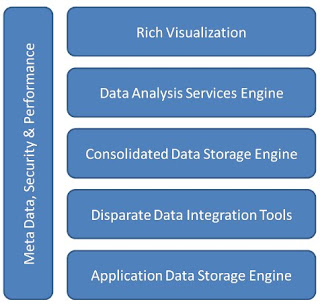
A Business Intelligence Application, from a layered architecture perspective would be represented as shown in Figure 1.

This framework is conceptual, and technology agnostic.


Figure 1.

1. The Data Integration will result in the Consolidated Data Storage

2. Data Analysis and Rich Visualization such as decomposition trees will use this Consolidated Data

3. The Consolidated Data can be termed as Data Warehouse OR Data Mart.


In the next blog, we will explore the Application Data Layer.

Until then; Cheers!!


Synergetics is Awarded as the "Best. NET Training Service Provider" by Microsoft.

Oracle-AMD Acquisition Speculation Flares Once Again

By Zewde Yeraswork, CRN

"AMD is not for sale, but we are happy to listen to any proposal which is in the interest of our shareholders," Meyer said at an industry conference in Barcelona, as reported by Reuters.

The speculation was sparked by comments Oracle CEO Larry Ellison made last month at Oracle's annual financial analyst meeting, in
which he said Oracle could soon acquire a chip company in addition to software acquisitions.

But at the Oracle annual stockholders' conference earlier this week, Ellison reiterated his interest in acquiring additional semiconductor and software companies, more so than new service offerings.

"My point really was that we are interested in buying intellectual property of all kinds," Ellison said, as reported by The Wall Street Journal . "We would be interested in certain kinds of semiconductor companies and software companies. Most of our acquisitions and the bulk of our strategy are in creating and acquiring intellectual property
, including chips."

By acquiring AMD, Oracle would gain access to the chip company's IP portfolio, adding hardware to its software acquisitions and moving closer to end-to-end control of the entire IT stack.

Oracle couldn't be reached for comment Thursday. An AMD spokesperson offered the following comment to CRN: "As a matter of policy, AMD does not comment on speculations or rumors, but I can confirm that AMD is not for sale."


Synergetics India: IT consulting and Training services on .NET 4.0, SQL server 2008 BI. Awarded as the Best. NET Training Service Provider by Microsoft.


Friday, February 18, 2011

Microsoft Releases Windows 7 and Windows Server 2008 R2

On ITVoir Network, Microsoft Releases Windows 7 and Windows Server 2008 R2 by Vinod Negi

Microsoft Corp. has announced the release to manufacturing of Windows 7 and Windows Server 2008 R2, the next versions of its flagship desktop and server operating systems. With the completion of this development phase, industry partners are readying products in time for the Windows 7 and Windows Server 2008 R2 worldwide general launches.

Windows 7 will be generally available to customers around the world on October 22, and Windows Server 2008 R2 will be generally available on or before that date. As always, current customers of the Windows Volume Licensing program, Microsoft Developer Network subscribers and TechNet subscribers will be among the first to get customer access to Windows 7 and Windows Server 2008 R2 in the coming weeks.

Microsoft will make the announcement on its Windows Team and Windows Server Blogs later today. More information about today’s news is available via the following links:

• Windows Team Blog, http://windowsteamblog.com

• Windows Server Blog, http://blogs.technet.com/windowsserver

• Partner Web sites, http://readyset7.com and http://talkingaboutwindows.com/Default.aspx

Windows 7 and Windows Server 2008 R2 for businesses,

Founded in 1975, Microsoft is the worldwide leader in software, services and solutions that help people and businesses realize their full potential.
Synergetics is Awarded as the "Best. NET Training Service Provider" by Microsoft.

Embarcadero taps into SQL Azure beta

By Alex Handy

Microsoft's cloud-enabled database platform, codenamed SQL Azure, isn't yet ready for prime time. But that hasn't stopped developers and database administrators from signing on to try it out.

To enable developers and administrators to better experiment with the SQL Azure beta, Embarcadero Technologies has partnered with Microsoft to release a free version of DBArtisan specifically tailored to help with the move to Azure.


SQL Azure is based upon some SQL Server technologies, but it is being specially crafted for the cloud. Scott Walz, senior director of product management at Embarcadero, said that both developers and Microsoft have questions to be worked out about how a cloud-based database should work.

As such, DBArtisan 8.7.2 does not i
nclude optimization features, nor does it offer deep monitoring capabilities. But that is because even Microsoft hasn't yet figured out how to give that type of information or power to users, said Walz.

DBArtisan focuses on migration and query tools. Because this is a free version limited to a 90-day trial, it is also only able to migrate Microsoft SQL Azure databases to Windows Azure. Walz said that the eventual commercial version of DBArtisan for SQL Azure will include migration tools for many different types of databases, but because the Azure platform is not complete, the decision was made to include only Microsoft-specific tools this time.

A primary reason for this release, said Walz, is to help both SQL Azure developers and Embarcadero figure out how to deal with SQL Azure. Because Microsoft has not exposed all of the traditional metrics and information available from a hosted database, both SQL Azure and DBArtisan's support for SQL Azure are works in progress.

One of the questions still remaining is how SQL Azure will present its process-monitoring information. Walz said that clouds are inherently multi-tenant systems, so looking up a system process table in SQL Server isn't something to be done lightly. He added that Microsoft is still working on solving this problem.


Optimization is another area where SQL Azure is still coming together, said Walz. When a developer sends a query into a cloud-based database, the developer asks, "How long does one wait before timing out the request?" Because SQL Azure is accessed via the Internet, times of up to five minutes per query could be normal, whereas on an internally hosted database, a five-minute query might be considered slow, Walz said.

Walz said that one of the benefits companies are looking for is the consolidation of databases that may be replicated around the world.
The vision is to have a single cloud that can take care of regional host replication automatically, reducing both capital expenditure costs and administration overhead.
Synergetics India : Our Database Offerings experience help to reduce the Opportunity cost for our clients in terms of development time specially related to latest in technology.

New Technology Adoption Strategy in 2011... Synergetics Approach

Rapid , Revolutionary and Broad reaching changes initiated by new product/platform launches in Information Technology space along with the evolutions of new programming Paradigms/Methodology in Software Applications Development space and releases of Newer Versions of existing product suites; first up spring multiple challenges on Knowledge Acquisitions aspect in these areas as well as on Skills Development side.


The broad classifications of challeng
es are:

* Knowledge acquisition
* Skill empowerment/improvement
* Moving in fast to stay ahead of competition

Most striking is ; along with these new challenges also come a whole new world of connected new business opportunities; which to encash means, move in fast and stay ahead of your competition. In fact these changes and disruptions provide redefinition to how business in general will operate in the future ; are most liked by SI and ISVs because this allows their business to thrive and reach newer heights ; gain newer clients with a refined set of new value propositions and new solutions.

For Software Services organizations i.e. SIs::System Integrators and ISVs ::Independent Software Vendors the primary challenge is to 1st identify and then adopt the most relevant technology/products/paradigm for its solutions spectrum, for its value propositions and for its client base.

They essentially need an unbiased opinion on the value of a technology and its business value propositions.

Identification of suitability of a particular technology is most crucial as Vendors create unprecedented Hype / Initial demand over each and every technology offerings and attempt to drive adoption even in the technology’s infancy stages putting the ISV / SIs in a quandary “ To adopt or Not to adopt ”. Early adoption gives First movers advantage which no software development organization wishes to miss. Business Drivers create Business Pressure.

The Vision v/s Hype kind of evaluation starts with getting to know Primary Feature / Functionality [FF] then getting to know What and Why aspects in the initial stages leading to the When and How then to Do’s and Don’ts and eventually to the Best and Next practices [BNP] aspects. The premium knowledgebase is the one that enables architecture and architecting of a solutions in these new technology space.

These changes and disruptions induce a redefinition as to how business in general will operate in the future.

This opens up opportunities for SI and ISVs, as:

* This allows their business to thrive and reach newer heights
* It provides them the basis for acquiring newer clients and/or providing refined set of value propositions and solutions.

The SI and ISVs hence need to 1st identify and then adopt the most relevant technology / products / paradigm for its solutions spectrum, for its value propositions and for its client base.

They essentially need:

* An unbiased opinion on the value of a technology and its business value propositions.
* Identification of suitability of a particular technology is most crucial as Vendors create unprecedented Hype / Initial demand over each and every technology offerings
* undertaking early adoption, as it gives a First mover advantage which no software development organization wishes to miss.

The Vision v/s Hype kind of evaluation starts with Getting to know Primary Feature / Functionality

* Then getting to know What and Why aspects in the initial stages
* Leading to the When and How
* Then to Do’s and Don’ts and
* Eventually to the Best and Next practices aspects.

This premium knowledgebase is the one that enables the architecture and architecting of the solutions in the new technology space.

Knowledge acquisition for various spectrum of professionals in a software development organization eventually followed by Skills Development for its front line staff that produces results is paramount.

Our Core Training interventions

* Deliver on Peoples Technology Competency roadmap / Certification roadmap as defined by the organization .—“build competitive edge”
* Deliver Customized program for on-Bench people
* Deliver Customized program for people in technical transition

Our Specialized New Services have offerings:

1. Custom Solutions

2. Products

3. Events

Custom Solutions:

The objective of this service is to provide expertise in Building Custom Solutions/Products, Cater to Resolving Customer Pain Points across Organizational Processes/Adoption, and Improving Functional Areas.

The offerings that are classified as Custom Solutions are:

· On Boarding

o To Build Competitive Advantage for Business through Process Effectiveness, Innovation & Project Readiness of Fresher

· Project Readiness

o Allow key stakeholders to define their requirements and close important gaps before any significant work and investments begin

· Evangelism

o Partner with Customers/Vendors in Product Pre Launch Activities

Products:

Products are aimed at bridging technology and skills gaps, by publishing innovative content designed and delivered by our experienced consultants, with an average industry experience of 10 years.

The offerings published are:

· Theme Based Program

o Conduct workshops framed around topics / rhythms prevalent or addressing community needs.

· Webinar

o Host Live Web Sessions for current & emerging technologies; showcasing integration, interoperability, and development knowledgebase.

· Video

o Publish Current Technology Multimedia Content for far reaching aspiring developers.

· Real World Project

o Provide competency building deep dive, end to end hands on workshops for aspiring and experienced developers.

Events

Synergetics, would like to engage and reach out far and wide to existing customers and beyond, to the entire community of the I.T. industry. Events will create the forums which will allow for exchange of ideas and information, and enable the community, to scale up and reach out to each other.

The forums will be targeted at:

· Developer

A forum for Developer Oriented Knowledge Transfer of emerging technologies

· Vendor

Participate in Various Annual Events of Vendors and ISV/SI

· Wisdom

A forum showcasing WOW sessions across ISV/SI community for extending existing product knowledge and capabilities

Our 15+ years to deep connection with the Developer community as listed below; we get to see that they desire knowledge and skills on different levels as per their role.

Synergetics India : Consultants being awarded as Microsoft's Most Valuable Professional & also Consultants being awarded as Microsoft Certified Application Developer.

Windows 7 Embedded adds multimedia modules

By David Worthington

Windows Embedded 7 Standard, an embedded edition of Windows 7, introduces new multimedia modules, energy saving options, and management capabilities for specialized enterprise and consumer devices.

Microsoft shipped Windows Embedded 7 Standard in late April at the Embedded Systems Conference in San Jose. Several of its partner's solutions and its own reference hardware were demonstrated during the conference.

Those included multi-touch kiosks built with Intel hardware, industrial automation products from Siemens as well as Microsoft's concept of set-top boxes for integrating PC and Web-based multimedia with televisions. Partners have been working with Windows Embedded 7 since September, when a preview version was released.

The primary focus of Microsoft's emb
edded products has been on enterprise-class devices, but Microsoft is now targeting the consumer marketplace with new Windows Media Center components and Windows Presentation Foundation-based UI controls, said Ashwin Kulkarni, senior product manager for Windows Embedded.

Developers also have access to Windows 7's multi-touch, Windows Flip 3D navigation and Windows Aero user interfaces. Other technologies found in Windows Embedded 7 Standard are Internet Explorer 8, Microsoft Remote Desktop Protocol 7.0, Windows Media Player 12 and Microsoft .NET Framework 3.5 Service Pack 1.

The core product footprint is 400MB, Kulkarni said. Microsoft's development tools take dependencies into account as images are created, he said.
Synergetics is Awarded as the "Best. NET Training Service Provider" by Microsoft.

Thursday, February 17, 2011

Microsoft sets rules for Windows Phone app distribution

By David Worthington on SDTimes

New Orleans — With an eye to the consumer market, Microsoft has unveiled the policies that will govern how consumer and enterprise applications are distributed in the Windows Phone Marketplace.

Yesterday, at its TechEd conference, the company revealed that developers would have no limit on the number of paid applications that can be submitted to the store. Developers will receive five free submissions per registration; further registrations will cost US$19.99 each.

Marketplace business models will provide for ad-supported, free, “freemium” and paid applications. Distribution can be public or private. Private distribution is available for a predefined set of people to review applications, which was done with an eye to the enterprise, said Brandon Watson, director of developer experience for Windows Phone 7.

Microsoft will furnish development partners with Windows Phone 7 devices in July, he said. Applications will be written in a hybrid version of Silverlight 3, which includes elements of Silverlight 4, he said. HTML 5 will not be supported.

Developers can port Silverlight 4 desktop applications to Windows Phone 7; however, they should optimize for the experience that they are delivering, Watson said. Windows Phone 7 will introduce a new interface called “Metro,” which exposes application notifications through tiles on the phone’s desktop.

Further enterprise functionality will become available through integration with Active Directory and support for policies. There will be more opportunities to extend functionality in the future, Watson said. “Those are just the tip of the spear.”

Microsoft is unaware of whether third-party component makers are building controls for Windows Phone 7, Watson said. “They all probably want to be first to market when the phone is available,” he remarked.

Synergetics is a premium brand in the Indian IT industry with an experience base of over 15 years in the area of people competency development; engaged in delivering it thru its training and consulting interventions , primarily focusing on their productivity with regards to the project and deliverables on hand